Professional made-to-measure digital sewing patterns — PDF · PLT · DXF AAMA

Minervainervabeta
#2410
#2412

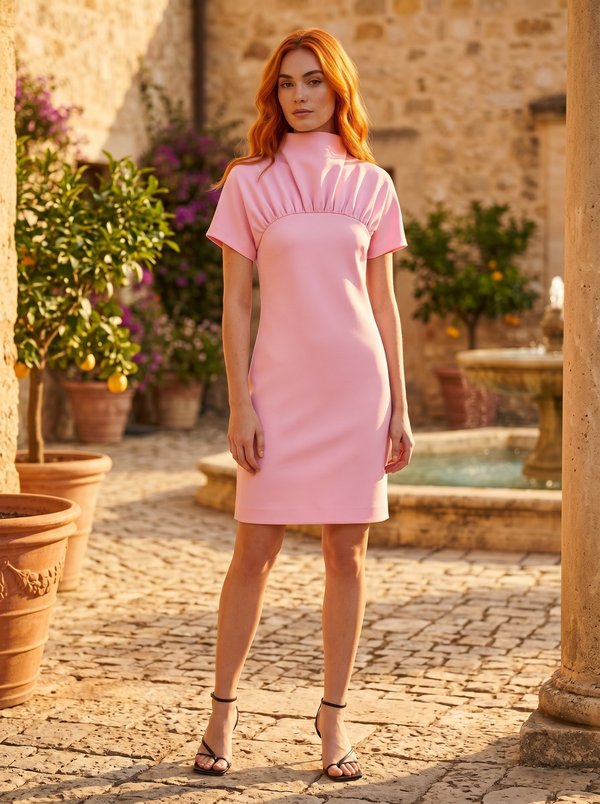
Shift Dress Mock Neck Cap Sleeves

Pattern #2411

A women's straight dress just above the knee, with cut-on cap sleeves, a folded stand-up collar, a shaped front yoke seam and slanted single-welt pockets. Concealed zip in the centre back seam. Drafted to your own measurements. Recommended fabric: firm, dense dress fabrics made from natural or blended fibres.

Tech. Description

Shift Dress with Mock Neck

A women's straight dress just above the knee, with cut-on cap sleeves, a folded stand-up collar, a shaped front yoke seam and slanted single-welt pockets. Concealed zip in the centre back seam.

When To Wear

  • For the office in autumn and spring, on its own or with a jacket or cardigan.
  • With a belt at the waist (recommended), for daytime and evening wear.

Key Design Features

Silhouette: Straight shift shape, shaped at the back with waist darts.

Length: Just above the knee.

Collar: A one-piece collar folded lengthwise, standing up away from the neck; the outer layer is sewn to the neckline and the inner layer stitched in the ditch.

Sleeves: Short cap sleeves cut in one with the bodice; the armholes are finished with a 4 cm bias binding turned to the inside and topstitched.

Front: An upper front cut on the fold, joined to the lower front by a horizontal yoke seam that rises to a point on each side towards the armhole. The lower front is cut in two pieces with a centre front seam.

Pockets: Slanted single-welt pockets on the lower front, with interfaced welts, lining-fabric pocket bags and a self-fabric facing on the large bag.

Back: Two pieces with a centre back seam and a concealed zip from the neck; vertical waist darts on each back piece.

Finishing: Hem turned up 2 cm and topstitched.

Level Of Difficulty

Intermediate. Single-welt pockets with diagonal corner cuts, a pointed yoke seam with clipped corners, a concealed zip and bias-bound armholes.

Fabric Recommendations

Firm, dense dress fabrics made from natural or blended fibres.

Additional Supplies

  • Concealed (invisible) zip
  • Fusible interfacing (welts)
  • Lining fabric for the pocket bags
  • Bias binding 4 cm wide, cut from fabric or ready-made

Cutter's Must

If the patterns have a double contour, the patterns include seam allowances; if the contour is single, the patterns do not include seam allowances. Seam allowances: all seams 1 cm. Hem allowance – 2.0 cm. Attention! First of all, print out the paper patterns and lay them out on the fabric width (fabric width can be from 90cm to 150cm) to determine how much material you will need (do not forget to account for paired and symmetrical pieces). When stitching pieces, pay attention to the notches - they must match!

  • From main fabric:
    • Back – 2 pieces
    • Lower front – 2 pieces
    • Upper front – 1 piece with fold
    • Welt – 2 pieces
    • Collar – 1 piece
    • Facing – 2 pieces
  • From lining fabric:
    • Large pocket bag – 2 pieces
    • Small pocket bag - 2 pieces
  • From fusible interfacing:
    • Welt – 2 pieces

Sewing Instructions

  1. Interface pieces with fusible interfacing.
  2. Stitch darts on back pieces, press allowances towards the center of the pieces.
  3. Overlock the center back seam separately on each piece. Stitch the center back seam from the zipper mark to the bottom, press allowances open. Insert the zipper.
  4. Mark the pocket placement on the front. Press the welt lengthwise in half, wrong sides together. Stitch the small pocket bag to the inner side of the welt. Stitch the facing to the large pocket bag. Stitch the welt to the front along the lower pocket marking line. Stitch the large pocket bag to the front along the upper pocket marking line. The ends of the stitching should finish at the short marking lines. Cut the pocket opening. Make diagonal cuts 1-1.5 cm from the end of the pocket. Turn the welt and large pocket bag through the opening to the wrong side. Secure the pocket ends from the wrong side with a double backstitch at the base of the corners. Stitch the pocket bag edges.
  5. Stitch the center seam of the lower front. Overlock and press allowances open. Stitch the lower front to the upper, clipping allowances at the corners. Press allowances upwards and overlock.
  6. Stitch shoulder seams, press allowances towards the back and overlock.
  7. Fold the collar lengthwise in half and stitch the ends. Trim allowances at corners, turn right side out and press. Stitch the outer collar to the neckline, fold under the allowance of the inner collar and topstitch into the seam. Press and overlock allowances.
  8. Cut (or use ready-made) bias binding 4 cm wide and equal in length to the armhole length + 4 cm. Fold the bias binding lengthwise in half, right side out, and press. Place the binding with the armhole edge, right sides together, and stitch. Fold the binding to the wrong side, clip allowances, and topstitch along the fold to the main piece. Press the seam.
  9. Stitch side seams, press allowances towards the back and overlock.
  10. Overlock the bottom edge of the garment, press to the wrong side and topstitch. The dress is recommended to be worn with a belt.

Order Pattern

Standard Sizes

Individual Measurements

Please double-check the file format and paper size. Your pattern is drafted in exactly the format you select; a different format or paper size later is a new order.

Similar patterns

View all
Support

Minerva Support

Online
Support
Hi! I'm Minerva's AI assistant. What can I help you with?