Professional made-to-measure digital sewing patterns — PDF · PLT · DXF AAMA
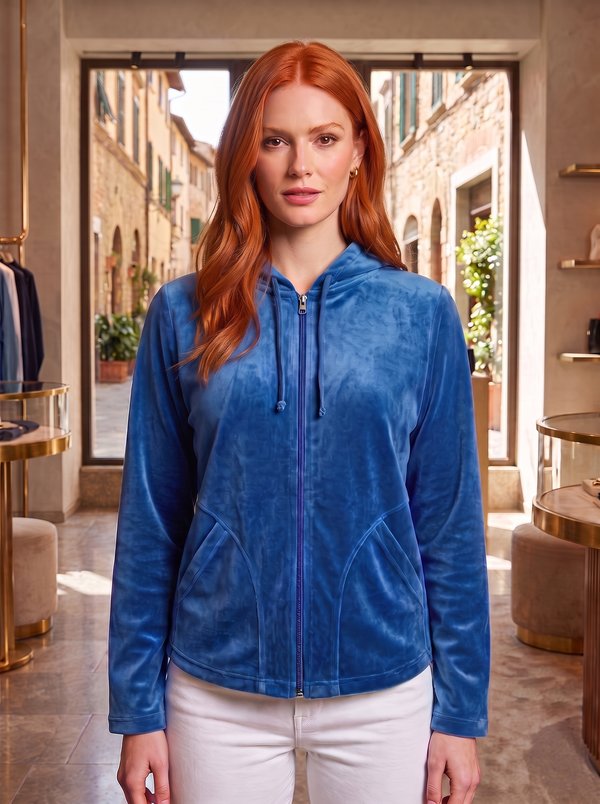
A women's hip-length zip-up hoodie in fleece or sweatshirt knit, with a two-piece drawstring hood, a full-length front zip and two patch pockets with slanted openings that meet at the zip like a split kangaroo pocket. The hood centre seam and the hood-to-neckline seam are covered with bias binding. Drafted to your own measurements. Recommended fabric: fleece or soft, thick knit such as sweatshirt fleece (French terry).
A women's hip-length zip-up hoodie in fleece or sweatshirt knit, with a two-piece drawstring hood, a full-length front zip and two patch pockets with slanted openings that meet at the zip like a split kangaroo pocket. The hood centre seam and the hood-to-neckline seam are covered with bias binding.
Silhouette: Straight, relaxed fit, hip length.
Collar: Hood made of two pieces joined by a centre seam, which is covered on the inside by a folded strip of bias binding topstitched to the hood. The front edge is turned in as a casing for a drawstring that exits through two interfaced buttonholes.
Closure: Separating zip from the hem up to the neckline, backed by centre front facings that run up into the hood and are tacked to the shoulder seams.
Pockets: A patch pocket on each front with a slanted, turned and topstitched opening; the two pockets sit side by side at the zip.
Sleeves: Long, set in flat before the side and sleeve seams are closed in one line; hems turned up and topstitched.
Back: Plain one-piece back; the back neck seam is covered with bias binding that runs 1.5–2 cm onto the fronts.
Finishing: Seams sewn with a stretch or narrow zigzag stitch and overlocked; body and sleeve hems topstitched with a twin needle.
Intermediate. A full-length zip with facings in a thick knit, a hood set together with facings and bias binding, and drawstring buttonholes.
Fleece or soft, thick knit such as sweatshirt fleece (French terry).
Tip: Cut pieces made from knit fabrics should be sewn with a special elastic or narrow zigzag stitch. When serging, trim seam allowances to 0.6 – 0.8 cm. The hem allowance is topstitched with a twin needle to maintain elasticity.

Minerva Support
Online