Professional made-to-measure digital sewing patterns — PDF · PLT · DXF AAMA

Minervainervabeta
#902873
#902883

Plus Size Fit-and-Flare Dress with Crossover Pleated Neckline

Pattern #902882

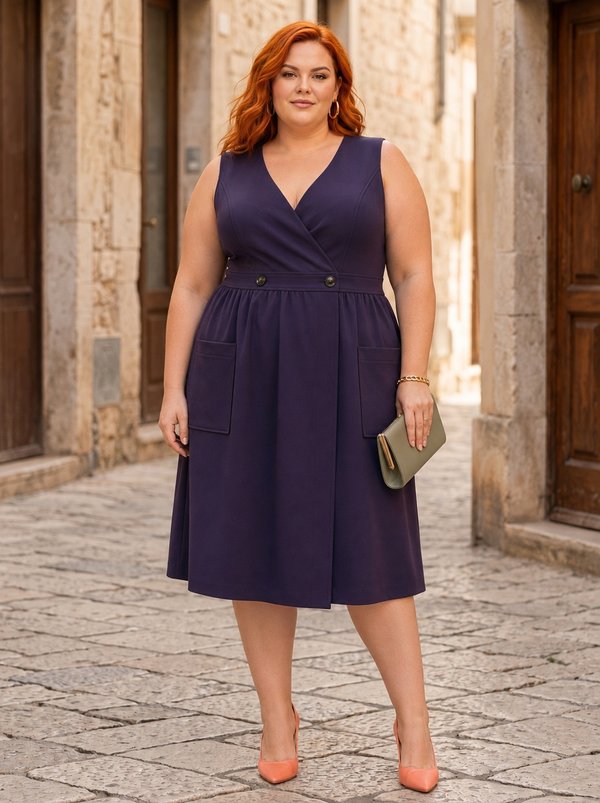
A plus-size women's sleeveless midi dress with a waist seam and a flared skirt. The V-neck is formed by faced extensions of the two upper fronts that cross at the centre front and are held by a decorative button; folded pleats run diagonally from the neckline and the skirt front has pleats at the waist. Drafted to your own measurements. Recommended fabric: dense dress fabrics made of natural or blended fibres.

Tech. Description

Plus Size Fit-and-Flare Dress with Crossover Pleated Neckline

A plus-size women's sleeveless midi dress with a waist seam and a flared skirt. The V-neck is formed by faced extensions of the two upper fronts that cross at the centre front and are held by a decorative button; folded pleats run diagonally from the neckline and the skirt front has pleats at the waist.

When To Wear

  • For the office and daytime events in spring, summer and early autumn.
  • With a jacket or cardigan in cooler weather.

Key Design Features

Silhouette: Fitted bodice with waist darts, skirt flaring from the waist seam.

Length: Midi, below the knee.

Neckline: V-neck. Each upper front has a shaped extension at the neckline, finished with an interfaced facing; the extensions cross at the centre front and are fixed with a decorative button. A stitched pleat folds diagonally from the neckline on each side.

Front: Upper front with a centre front seam and waist darts. The lower front is cut on the fold, with pleats folded upwards at the waist seam above short darts.

Sleeves: Sleeveless; armholes finished with a folded bias strip 4 cm wide, turned to the inside and topstitched.

Back: Centre back seam with a concealed zip from the neckline; darts in the upper and lower back; back neck facings.

Finishing: Hem overlocked, turned up 2 cm and topstitched.

Level Of Difficulty

Intermediate. A faced crossover neckline with corners, stitched pleats, a concealed zip and bias-bound armholes.

Fabric Recommendations

Dense dress fabrics made of natural or blended fibres.

Additional Supplies

  • Fusible interfacing (front and back neck facings)
  • Concealed zip
  • 1 decorative button
  • Bias binding 4 cm wide for the armholes, if not cut from the main fabric

Cutter's Must

If the patterns have a double contour, they include seam allowances. If the contour is single, the patterns do not include seam allowances. Seam allowances: all seams 1 cm; hem allowance for the dress bottom — 2 cm. Attention! First of all, print out the paper patterns and lay them out on the fabric width (fabric width can be from 90cm to 150cm) to determine how much material you will need (do not forget to account for paired and symmetrical pieces). When stitching pieces, pay attention to the notches - they must match!
  • From main fabric:
    • Upper back - 2 pieces
    • Lower back – 2 pieces
    • Upper front - 2 pieces
    • Lower front - 1 piece with fold
    • Front neckline facing — 2 pieces
    • Back neckline facing — 2 pieces
  • From fusible interfacing:
    • Front neckline facing — 2 pieces
    • Back neckline facing — 2 pieces

Sewing Instructions

  1. Fuse interfacing to the designated pieces.
  2. Stitch darts on the upper and lower back pieces, press allowances towards the center. Stitch the upper and lower back pieces together, press allowances downwards, serge.
  3. Serge the center back edges separately. Stitch the center back seam from the zipper mark to the bottom, press allowances open. Insert the concealed zipper.
  4. Stitch the waist dart on the upper front pieces, press allowance towards the center. Fold and stitch the upper pleat along the marked line. Clip the allowance at the corner, direct the pleat depth downwards.
  5. Serge the outer edge of the front neckline facings. Place the facing piece with the main garment right sides together and stitch the neckline edge and the extension up to the center edge. Clip allowances at curves, trim at corners, turn the piece right side out, straighten, press.
  6. Place the upper front pieces right sides together, folding back the facings and aligning the center seam. Stitch the center seam of the upper front, simultaneously with the center seam of the facing, press allowances open and serge. Turn the facing to the wrong side, secure to the garment's center seam.
  7. Clip darts on the lower front piece up to the pleat. Fold and secure the pleats, with depths directed upwards. Stitch darts, serge, press allowances towards the center. Stitch the upper and lower front pieces together, press allowances upwards, serge.
  8. Serge the outer edge of the back neckline facings. Place the facing with the garment right sides together and stitch the neckline edge. Start or end the stitching exactly at the marked shoulder seam line. Clip allowances at curves.
  9. Stitch the shoulder seams, inserting the front piece between the back and the back facing, press allowances towards the back and serge. Turn the facings to the wrong side and press. Secure to the zipper tape.
  10. Cut (if not ready-made) a bias binding 4 cm wide and a length equal to the armhole length + 5 cm. Fold the bias binding in half lengthwise right side out and press. Place the binding with the armhole edge right sides together and stitch. Clip allowances. Fold the binding to the wrong side and topstitch along the fold to the main piece. Press the seam.
  11. Stitch the side seams of the garment, press allowances towards the back and serge.
  12. Serge the bottom edge of the garment, press to the wrong side and topstitch.
  13. Sew the decorative button according to the marking, securing the right and left upper front pieces.

Features

Order Pattern

Standard Sizes

Individual Measurements

Please double-check the file format and paper size. Your pattern is drafted in exactly the format you select; a different format or paper size later is a new order.

Similar patterns

View all
Support

Minerva Support

Online
Support
Hi! I'm Minerva's AI assistant. What can I help you with?